Frankford Umbrellas: Aurora, Eclipse, and Monterey

If you’ve ever gone through a couple patio umbrellas in a short span, you already know the pattern.
They look fine at first, then the fabric fades, the frame loosens up, and the first decent windstorm exposes all the weak points.
That’s really where Frankford separates itself.
These aren’t designed to be replaced every season. They’re built more like long-term outdoor equipment, and once you start digging into the details, it’s pretty clear why.
Everything is designed out of Mount Laurel, New Jersey, and the focus is less on gimmicks and more on structure, materials, and how the umbrella actually performs outside.
Cantilever Umbrellas: Open Space, Full Control
If you want to get the pole out of the middle of your space, you’re looking at cantilever umbrellas. That’s where the Aurora and Eclipse come in.
Aurora Cantilever

The Aurora is the one most people start with, and it covers a lot of ground depending on how it’s configured.
It rotates a full 360 degrees and locks into position, so instead of moving your setup, you just swing the umbrella where you need it. The infinity tilt is what really makes it useful though. As the sun drops, you can keep adjusting the canopy angle and stay covered without chasing shade around your patio.
Where it gets interesting is the construction. Aurora comes in two versions.
One uses solid fiberglass ribs, which are designed to flex. When wind picks up, the umbrella gives a little instead of resisting it. That flexibility is what keeps it from taking damage in normal gusty conditions.
The other uses aluminum ribs, which feel more rigid and structured. It gives the canopy a tighter look, but with less movement overall.
Both versions use an aluminum mast with stainless steel hardware, and both are built around that same idea of being easy to operate without feeling flimsy. In terms of wind, you’re looking at around 25 to 30 mph, depending on the setup and whether you add a stabilizer.
It’s a very practical umbrella. Easy to use, adaptable throughout the day, and strong enough for most residential setups.
Eclipse Cantilever

The Eclipse takes the same concept and builds it heavier.
This is where you start seeing thicker aluminum throughout the frame, both in the mast and the ribs. It’s noticeably more solid once it’s set up, and that extra structure translates directly into wind performance.
You still get the same 360-degree rotation, but with more locking positions, so adjustments feel a bit more precise. The tilt system is just as flexible, but it holds its position more firmly under load.
Where the Eclipse really stands out is durability. It’s engineered for around 30 mph sustained wind, and closer to 35 mph with a stabilization kit. That’s why it shows up more in commercial settings or in areas where wind is a regular factor.
It’s not something you’re constantly moving around. It’s something you set up properly and rely on.
The Fabric

Across both cantilever models, Frankford uses a Sunbrella 9 oz marine-grade solution-dyed acrylic.
That basically means the color is built into the fiber itself, not just applied on the surface. So instead of fading unevenly or washing out after a season, it holds its color and structure for years.
It also has a slightly heavier, canvas-like feel compared to softer umbrella fabrics. That matters because it resists stretching and sagging over time, especially on larger canopies.
Monterey: The Traditional Umbrella Done Right

Not every space needs a cantilever. If you’re working with a dining table or a more traditional layout, a center-post umbrella still makes the most sense.
That’s where the Monterey comes in, and this is one of those models that doesn’t look overly complicated but is built extremely well.
The first thing to know is the frame uses half-inch fiberglass ribs. That’s thicker than what you’ll find on most residential umbrellas, and it’s intentional.
Fiberglass flexes under pressure, which is exactly what you want when wind picks up.
Instead of fighting the wind and bending permanently, the ribs move and return to shape. That’s a big reason the Monterey is rated for up to 40 mph winds when properly secured.
The center pole is aluminum, paired with stainless steel and resin components, so you’re not dealing with rust or constant maintenance.
Auto Tilt Monterey (What Most People Choose)
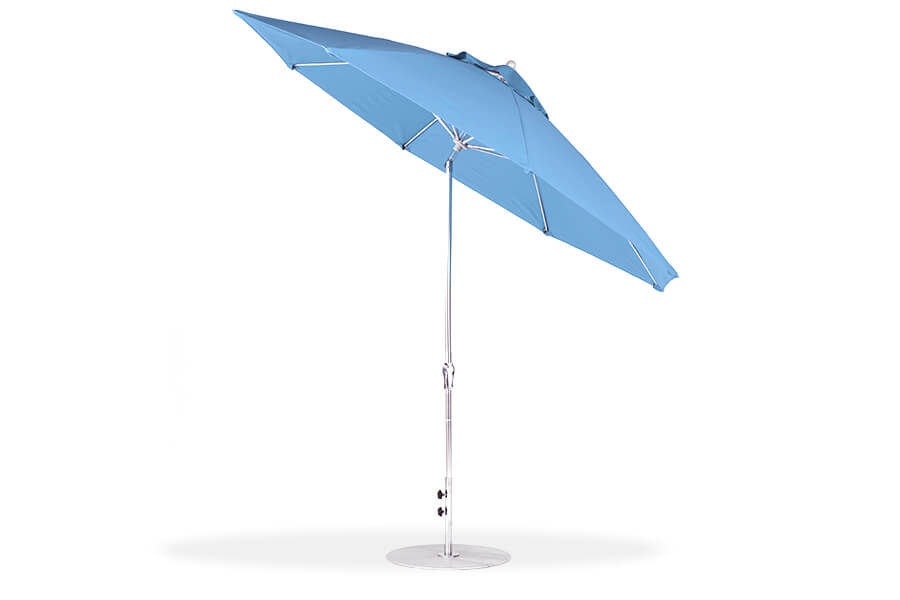
The auto tilt version is where everyday use gets easier.
Instead of a separate tilt mechanism, everything is built into the crank:
Open the umbrella like normal
Keep cranking, and it gradually tilts up to about 30 degrees
It locks into place automatically, and the system itself is built from a zinc alloy, so it’s strong enough to handle larger canopies without wearing out.
You still get that same fiberglass rib structure, so even when tilted, the umbrella holds up well in normal wind conditions.
Built Like It’s Meant to Last
A few small details that actually matter over time:
316L stainless steel crank components
Reinforced stitching and multi-layer fabric construction
Thick center pole with a solid feel, not hollow and flimsy
Multiple lift options if you don’t want auto tilt (pulley or standard crank)
It’s available in several sizes, from smaller patio setups to full 11-foot coverage, so it works whether you’re shading a table or a larger seating area.
What It All Comes Down To
Each of these umbrellas solves a slightly different problem.
The Aurora is flexible, adjustable, and easy to live with day to day
The Eclipse is heavier, more rigid, and built for tougher conditions
The Monterey keeps things simple but uses stronger materials than most traditional umbrellas
The common thread is that none of them are built to be replaced in a year or two.
The frames stay tight, the fabric holds up, and if something does happen, they’re designed to be repaired instead of tossed.
That’s really the difference. Not how they look on day one, but how they hold up after a full season outside.